Mathis Dumas & Therm-ic set their sights on a new summit

Mathis Dumas & Therm-ic set their sights on a new summit

A boisterous child who grew up in the low mountains, Mathis Dumas was not destined to become a famous mountaineer, known to the general public and recognised by his peers. However, through passion and hard work, he has climbed his way to the top, giving his life an unusual and inspiring vertical trajectory. A mountain guide, photographer and content creator, this hybrid athlete shines through his versatility and ability to bring back beautiful images from places few people are able to access.

Today, at Therm-ic, as experts in thermoregulation, we are proud to partner with Mathis Dumas. His commitment is a recognition of the performance and reliability of our current products, but also a promise of even more successful future developments. Because that is where the new summit lies that we want to climb together, as a team: pushing the limits of innovation even further.

Who is he? What is his advice for managing the cold and heat in the mountains? How did our heated gloves and socks contribute to the success of the “Kaizen” project with InoxTag? What is the vision for this new partnership? Mathis Dumas answers all these questions in an interview of rare authenticity.

"A mountain guide, photographer and content creator, this hybrid athlete shines with his versatility and ability to bring back beautiful images from places few people are able to access. "

MATHIS DUMAS, A HYBRID ATHLETE

Could you introduce yourself in a few words for those who don't know you yet?

I'll try to give a very brief introduction. My name is Mathis Dumas. I'm 31 years old. I'm a mountain guide, mountaineer, photographer and content creator. In particular, I helped InoxTag realise its “Kaizen” project by accompanying it to the summit of Everest. Recently, I have also become a film director, with the recent release of a feature film dedicated to my friend and skier Léo Slemett: “Better Up There”, which can be seen throughout the autumn at the “Montagne en scène” festival. I try to build synergies between all these roles, because behind these three professions lies the same desire: to promote the mountains and the values associated with them to as wide an audience as possible; to convey and make this passion accessible through keywords such as team spirit, nature, respect for the environment, pushing oneself beyond one's limits, disconnecting...

What motivates you to spend so much time in the mountains? Why is it so important for you to go up there?

For several reasons that all come together at the summit. First of all, to be in contact with nature, wild and unspoilt. I know of no purer joy than exploring, discovering something new and gazing at magnificent landscapes stretching as far as the eye can see, with an unrivalled feeling of tranquillity linked to silence and isolation... Secondly, I go there to disconnect from the fast pace of life and the virtual world. This need has become even more palpable since the release of the documentary Kaizen, which boosted my profile and turned me into a public figure, with all the positive and negative implications that entails. Finally, I go there for the pleasure of sharing, of experiencing a shared adventure, as part of a rope team. Up there, we forge bonds of rare strength. In short, I'm not looking for risk-taking or commitment.

‘Up there, we forge bonds of rare strength.’

How do you reconcile the athletic performance of mountaineering with the artistic dimension of photography?

The two feed off each other. They are like communicating vessels. On the one hand, documenting the performance and photographing the athlete in their natural environment makes it easier to tell a powerful and authentic story. And on the other hand, the prospect of capturing beautiful images encourages me to push myself. This hybrid athlete-photographer dimension is what has allowed me to stand out. Being an athlete with the ability to create beautiful, unique content. Or being a photographer capable of going where few people are able to go.

‘This hybrid athlete-photographer dimension is what has allowed me to stand out.’

EXPLORING AND PUSHING THE BOUNDARIES OF INNOVATION

How did your partnership with Therm-ic come about? How is it a natural fit?

I have been using Therm-ic products for several years, even before this collaboration began. Initially as an ordinary consumer, because there is no other brand on the market that offers outdoor heated equipment that is reliable, technical and lightweight enough for mountaineering or high-altitude climbing. The heated mountaineering gloves and heated mountaineering socks played a fundamental role in the realisation of the “Kaizen” project. They helped us to successfully climb Everest with InoxTag. From there, it seemed natural to build something more “official” together. I am a gear geek. I want to contribute to the momentum that Therm-ic is driving: pushing the boundaries of innovation in thermoregulation technologies. This collaboration and reflection on product development is therefore a logical continuation of my desire to continue exploring and increasing safety in the mountains.

‘There is no other brand on the market capable of offering outdoor heating equipment that is reliable, technical and lightweight enough for mountaineering or high-altitude mountain climbing.’

What are your favourite Therm-ic heating products? And how do you use them?

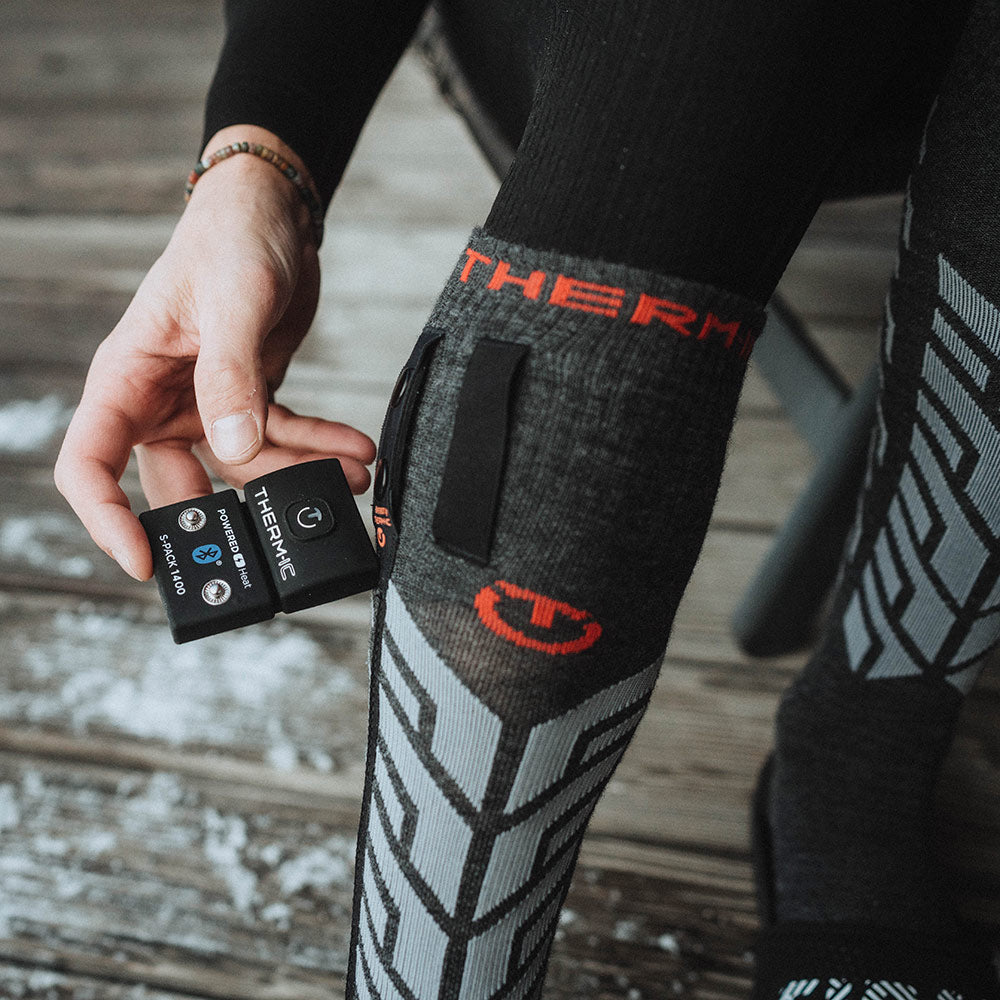
I can think of three products that are real game changers and have a positive impact on my daily activities. First of all, heated socks. On Everest, temperatures can drop to -25 or even -30°C. So we would switch them on at night, using InoxTag, to get to sleep or to make the approach with a head torch in minimum comfort. Secondly, for most of my shoots in the cold, I use Thin Ultra Heat Liner S.E.T® heated undergloves. They allow me to fly a drone or take photos without exposing my hands to the wind, snow or moisture. Finally, I really appreciate the Grip Shield Gloves with the revolutionary HDry membrane. I take them with me on all my winter outings because they offer the perfect compromise between exceptional thermal comfort, optimal grip and amazing dexterity. They provide impeccable protection while allowing for technical manoeuvres, particularly with ropes and carabiners.

Do you have any memories of expeditions where thermoregulation – i.e. effective management of cold and heat – was a real challenge to success?

Definitely during our ascent of Everest with InoxTag. The temperature range is enormous. You can go from -30°C at dawn to +15°C a few hours later, once the sun has risen. In this context, it becomes very challenging to equip yourself, as you need to protect yourself from the cold without sweating, because up there, humidity is the worst enemy of comfort. That's why it's important to use products with good breathability. I also remember filming a steep skiing movie on Baffin Island in north-western Canada. It was -20°C all the time, but it was very difficult to regulate your body temperature. Climbing up the couloir, we were warm, but as soon as we stopped to take a few shots, the polar cold would seize us. It was one of the most gruelling expeditions I've ever been on! (A moment's reflection) When I think about it, thermoregulation is still a real challenge for me. I remember a photo shoot on an icefall in Norway, in the Lofoten Islands, where I was hanging in mid-air, motionless, wondering whether or not I was going to turn into an ice cube; or more recently, a short climb on the Cosmiques ridge with rapper Bekar, where we all got extremely hot while navigating through a metre of fresh snow!

PROFESSIONAL ADVICE FOR MANAGING YOUR THERMAL COMFORT IN THE HIGH MOUNTAINS

Do you have any advice for managing the cold and heat and ensuring good thermoregulation in the mountains?

First of all, keep in mind that in the mountains, cold is not your only enemy: heat is too! I see a lot of people who tend to overdress for fear of getting cold, but in reality, they sweat and make the situation worse. Moisture – whether from external conditions or perspiration – is a real nuisance. Not only does it indicate severe dehydration, but being wet also makes you feel colder and increases the risk of blisters! In short, to avoid sweating, you need to find the right level of exertion. Don't burn yourself out. Go at your own pace, without overdoing it. Next, my second piece of advice would be to apply the same system to gloves as to technical equipment: the three-layer principle (or TLS, “Techno Layering System”). A breathable first layer, an insulating middle layer, and a protective, waterproof outer layer are very effective in combating the cold.

‘I see a lot of people who tend to overdress for fear of getting cold, but in reality, they end up sweating and making the situation worse.’

You recently wrote “L'Ascension”, a book that tells your story, that of a little boy who grew up in the low mountains and now thrives in the high mountains. How is a book different from a film, and what messages did you want to convey?

In my opinion, a book is much more timeless. At least, that's how I see it. The idea behind “L'Ascension” is to recount my journey and use it to motivate young people to take up sport. To guide them towards a career they are passionate about. To give them hope. To help them identify with my journey, which has been winding and far from predictable.

‘The aim of this book is to share my journey and use it to motivate young people to take up sport. To guide them towards a career they are passionate about. To give them hope.’

Speaking of messages and values, what do you want to convey through your partnership with Therm-ic?

The first thing is the geographical proximity, which necessarily leads to human proximity. It's a French company, which is important to me. Secondly, Therm-ic is a brand that innovates a lot. That naturally appeals to the equipment geek in me. I'm excited by this desire to always be at the cutting edge. I want to contribute to this dynamic and use my expertise to develop even more technical and high-performance heated gloves and socks.

To conclude this interview, what are your short- and medium-term plans?

In the coming months, I am keen to “support” my projects, bring them to life and promote them. Whether it's the book “L'Ascension” or the film “Better Up There” with Léo Slemett. Then, next autumn, I'd like to ski an 8,000-metre peak and document the project. But one thing at a time! First, I'm going to savour the work that's been accomplished.

‘I want to contribute to this dynamic, to bring my expertise to bear in developing even more technical and high-performance heated gloves and socks.’