Juliette Willmann: two films to write a new chapter

Juliette Willmann: two films to write a new chapter


Her documentary “Rise” made a big impact on the mountain world. The beauty of the images, the humility of the approach, the authenticity of the narrative: by bringing these ingredients together, Juliette Willmann had – unanimously – made a “great” ski film! Hard to do better than that? Yet the young freerider from Chamonix – established on the FWT, but now a fan of steep skiing – is giving it a go, and twice over!

She is back this winter with two completely different films, which have only one thing in common: the desire to ride and the indelible mark they leave on the viewer. With “Ski Yatra” (see the film at the end of the article) – a joyful expedition with friends to Nepal to ski peaks over 6,000 metres high – and “Alignée” (see the film at the end of the article) – a face-to-face with herself to question her deepest motivations – Juliette Willmann has created two high-quality films!

Meet the woman who will make you want to ski, combining camaraderie and introspection.

"The beauty of the images, the humility of the approach, the authenticity of the discourse. "

FREEDOM, DISCIPLINE & ENDURANCE

Two years ago, you started a new chapter, moving from Freeride World Tour competitions to freerider skiing, particularly steep skiing. Two winters later, looking back, how do you feel about this transition? Are you happy with your choice? What change was the most difficult to come to terms with?

I'm really happy with how things have turned out. I don't miss competing at all. I fully embrace what my new career allows me to do: set off on adventures, wherever my skis take me. Before, riding could sometimes feel like training; now, it's purely for pleasure. I indulge my passion for skiing in all its forms, regardless of the size of the ski or the steepness of the slope.

During this transition period, the most difficult change was working on my ability to adapt. You are constantly adapting to the weather, the snow conditions, and your physical and mental state. You can no longer rely on the structure and timing that competition provides. You certainly gain a new freedom, but to make the most of it, you have to be disciplined and even more driven.

"I fully embrace what my new career allows me to do: set off on adventures, wherever my skis take me. ‘

How does this career change affect your daily life? Is a typical day in winter different from before?

First of all, my season is no longer dictated by the competition calendar but by a more global film project. This requires deeper motivation, as it's no longer just a question of aiming for peak fitness for a few specific ’D-days" during the winter. Beyond that, however, I haven't noticed any major changes. I'm still committed to a high-level approach, structured around a well-regulated routine. I do the same things as before.

However, my perception has changed. I no longer train, I develop. I no longer tick off sessions, I spend time up there. (A moment of reflection) I also dedicate more days to partners, to coaching groups of skiers. I'm increasingly enjoying this idea of passing on my knowledge. I see it as a prospect for the future.

"I'm no longer training, I'm developing. I'm no longer ticking off sessions, I'm spending time up there. "

What are the main lessons you've learned from your new practice? What qualities have you developed to become a different skier?

The first quality I developed – without hesitation – was endurance! Because when you start an expedition, you know when you're leaving but never when you'll be back. You have to constantly adapt and respond to the unexpected... In short, I discovered a little potential in myself: I'm not capable of going fast, but I now know how to go for a long time! Then you learn to better manage the stress associated with commitment and risk-taking. You have better control over situations and are less prone to panic.

Finally, I have achieved a more overall sense of calm. I feel more relaxed and fulfilled than before. I no longer force myself. I carry out projects because they make me happy, not to prove something to others. I know that this is how I perform best and that I will meet expectations. Let's just say that my work ethic has become healthier.

‘I'm not able to go fast, but I now know how to go for a long time!’

SPONTANEITY, FACE-TO-FACE & SUPERHEROES

You released two films this winter: “Ski Yatra” and “Alignée”. What does making a film mean to you? Promoting two works in the same winter is quite rare: aren't you afraid they'll cannibalise each other?

From my point of view, film is essential for conveying messages and telling people what we do and what we experience. It's a different way of communicating than social media. With films, we can take the time to say who we really are. It gives the audience the opportunity to discover and become attached to a character. And no, I'm not worried about interference between our two films. They coexist because they complement each other.

They allow me to express two visions of my profession, of my passion. “Ski Yatra” is a very raw and immersive reportage, almost handheld, of an expedition with friends in Nepal; “Alignée” is more like a classic film, thought out, conceptualised... One is very spontaneous, the other more thoughtful!

‘It's a different way of expressing yourself than on social media. With films, you can take the time to say who you really are.’

Can you go into detail about each of these two films? What are viewers about to discover?

“Ski Yatra” tells the story of a group of friends who set off for Nepal to try to ski down peaks over 6,000 metres high. It's a joyful human adventure that promotes friendship and cultural exchange, while also being intertwined with hardships and unexpected events. On the agenda: light-heartedness, good humour and magnificent landscapes! “Alignée” was produced by the same production company as the film “Rise”.

Our initial intention was clear: to break the mould by offering a ski film that we are not used to seeing! So we went for an original format: a face-to-face with myself, like a therapy session that invites me to publicly express my doubts and questions: what motivates us? Why do we make films? What does it mean to be a professional skier? The feedback has been extremely positive in terms of showing riders in a different light than as superheroes, through an assumed sensitivity and vulnerability.

‘Ski Yatra’ tells the story of a group of friends who travel to Nepal to try to ride peaks over 6,000 metres high.

What do you think makes a good ski film?

In my opinion, a good ski film is one that allows you to discover a skier's talent, but also who they really are. It showcases the athlete without forgetting the person behind them. (Another pause for thought) A good ski film also needs to stand out. This is particularly challenging today because many avenues have already been explored. It's getting harder and harder to surprise the audience and get them to say ‘Wow!’

‘In my opinion, a good ski film is one that allows you to discover a skier's talent, but also who they really are.’

Making a film is an end in itself, but it's also a means to an end... Why do you do it? What are you looking for, and what do you find?

The desire to make a film always stems from a question. A question that I know I will find the answer to along the way. So, in a way, when you make a documentary, you agree to write yourself a question mark that will take you out of your comfort zone but, in doing so, allow you to grow as a person.

It's also an opportunity to open up and accept who we really are. This transparency, which comes from being natural and authentic, touches people. And I think that's cool!

Speaking of purpose, if you had to sum up your two films in two mantras, what would they be?

For “Ski Yatra”, I would say: ‘The important thing is not to perform, but to have a good time together!’ As for “Alignée”, the message would be to embrace the life we have: ‘Enjoy it to the fullest, without forgetting to challenge yourself to keep moving forward!’

‘The important thing is not to perform, but to have a good time together!’

EXTREME COLD, HEATED GLOVES & HYDRATION AT ALTITUDE

You have pursued your passion for skiing in a variety of contexts, from Nepal to the Chamonix Valley. Can you describe the different thermal environments in which you have skied?

Overall, I spent my season in extreme cold! In Nepal, due to the altitude, it could be -5°C in the sun during the day, but down to -25°C in the early morning. Around Mont Blanc, at home, I experienced temperatures between 0°C and -15°C. There is always this subtlety associated with our sport: the changes in body temperature inherent to the effort: you feel hot when you climb and cold when you descend... Thermoregulation was a key issue in making these two films, and in this context, equipment played a major role.

"Overall, I spent my season in the extreme cold! "

Speaking of equipment, can you describe the Therm-ic gear you usually take with you?

1/ I always take two pairs of gloves. One pair of lightweight, breathable gloves for the climb; the other warmer and more robust, with a focus on insulation and waterproofing, for the descent or technical approaches that require the use of your hands. These can also be heated gloves for women.

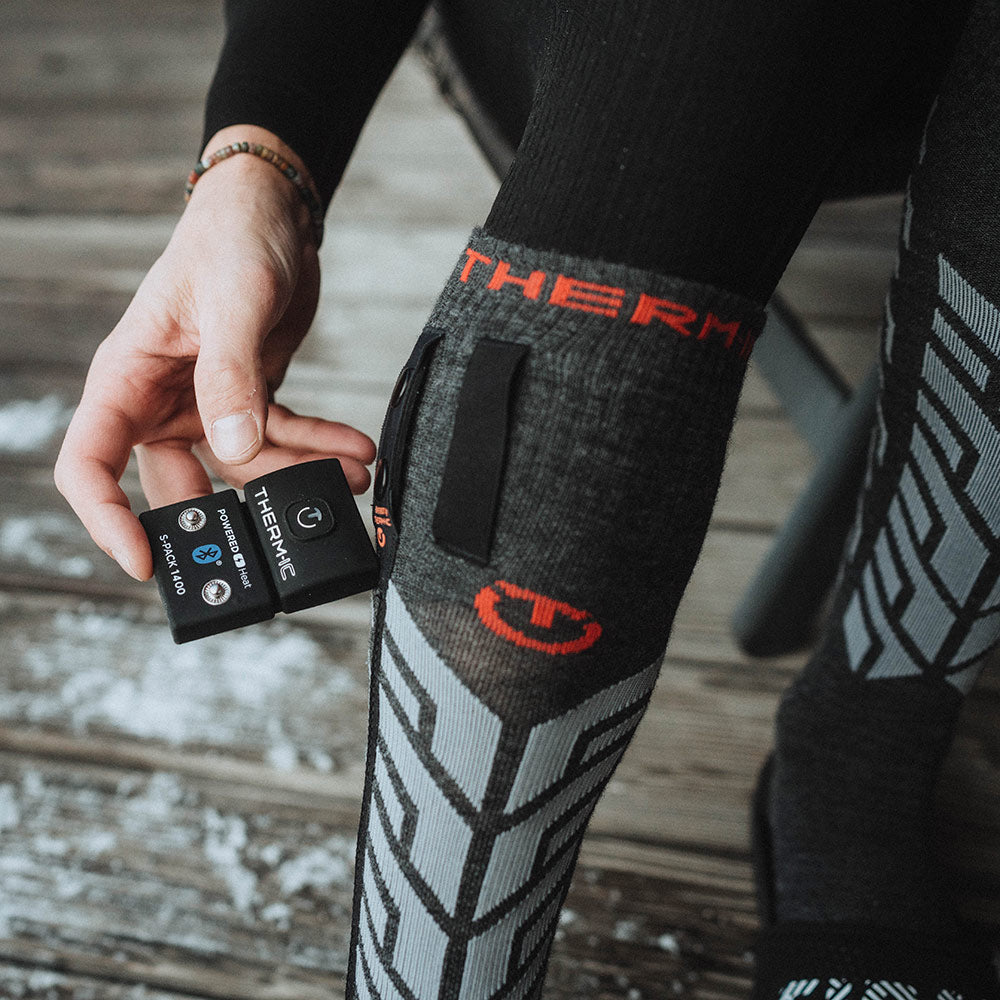
2/ I use high-performance heated socks on every outing. I activate the minimum heating level when I set off in the morning and adjust the intensity according to the conditions encountered during the day. For example, in Nepal, I activated “Boost” mode every time I crossed a river.

3/ I always take two heated base layers for women with me and take the time to change this base layer when switching from climbing to descending, even if it means gritting my teeth for a few seconds during the transition. Because if I stay wet, I'll never warm up!

4/ Finally, I never go out without my Therm-ic neck warmer. It's a key piece of kit, which I sometimes use as a balaclava!

‘I always take two pairs of gloves. One pair is light and breathable for the climb; the other is warmer and more robust for the descent.’

‘If I stay wet, I'll never warm up!’

To conclude, do you have any advice other than equipment to help manage thermoregulation and avoid cold hands and feet when skiing?

The main mistake I see people make is to over-equip themselves for fear of the cold. This causes the body to sweat, which is counterproductive since moisture is actually the worst enemy of comfort! In short, you need to find the right balance between being too hot and too cold. Heated products can be a good solution in this regard. Finally, I would advise paying attention to hydration and nutrition. I've only recently become aware of this, but since I've been drinking and eating regularly during my outings, at least once an hour, I feel that I can last much longer and, above all, that I recover better from one day to the next during my long expeditions.

"The main mistake I see people making is setting off with too much equipment for fear of the cold."

Ski Yatra

Alignée